TOS 65 - Windows on a Lost World by Star Trek
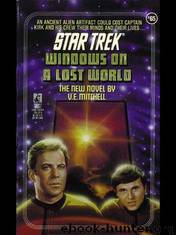
Author:Star Trek [Star Trek]
Language: deu
Format: epub
Tags: \Star Trek
Published: 2011-01-02T07:58:57.535000+00:00
of these creatures." Spock ran his tricorder
over Kirk's head and throat, concentrating on the
areas where the vocal apparatus was found in most
creatures.
"I beg your pardon, Mr. Spock?"
Hernandez was a small woman with an
aggressive, determined manner, but at the moment
a nervous frown wrinkled her forehead.
Spock looked up from his tricorder screen.
A sharp gust of wind ruffled his bangs before moving
on to other mischief. "I presume that your
tricorder reports no evidence of any vocal
apparatus capable of reproducing a spoken
language."
"Yes, but Dr. McCoy's autopsy
report implied that we were dealing with an
individual abnormality in the alien he
autopsied." After a moment's delay, the light
dawned for her. "You mean none of these creatures
has the capability of producing a spoken
language?"
"That covers the facts we have observed so far,
Doctor. Have you discovered any relevant
information that we have omitted from our analysis?"
Spock circled Kirk, studying the Kh@fflict
anatomy.
A sense of relief, which washed his mind with a
soft apricot haze, swept through Kirk.
Spock had deduced how the Kh@fflict
communications system worked. That meant he had
only to manipulate the alien's physiology
long enough to tell Spock what had happened to him.
With the colors and patterns being controlled by the
Kh@fflict lower brain, his prospects of
bypassing the programmed responses seemed
remote.
Suddenly he knew what to do. If his lower
brain projected designs on his carapace in
response to his thoughts, he could alternate between
two contrasting ideas to produce a message in
old-style Morse code. The question was, did
he remember the signals well enough to get
Spock's attention on the first try? If he
didn't, he wasn't sure he would have a
second chance. Unless he got past the
obstructions created by the Kh@fflict programming
soon, Spock would return to the artifact to work
on the puzzle from that end.
Kirk tried to remember the games he had
played with his brother when they were children. One
vacation at his grandparents' home in Vermont,
he, Sam, and the three McLaughlin boys from the
adjoining farm had spent an entire month
pretending they were Indians battling the invading
white settlers. Their long-range communications
system had been a set of talking drums they had
built from designs Tommy McLaughlin had
scrounged off the computer network. At the time none
of them had considered that their parents, whom they had
cast in the role of the invading British, were as
capable of translating their messages as they
were. Still, by the end of that summer, Kirk had been
proficient at using Morse code, and he
felt he should remember it, even if he had not
used it much in the intervening three decades.
The next question was what would catch Spock's
attention the fastest. The traditional SOS was a
simple, repetitious pattern that would give him
a chance to experiment with controlling the Kh@fflict
physiology. On the other hand, signaling his name
would tell Spock what had happened, but the longer
and less regular pattern to the letters spelling
"Kirk" increased the chance that he wouldn't be
understood. In addition, once he got Spock's
attention, he could repeat complex messages
until Spock understood them.
His decision made, Kirk concentrated on
"communication" until the interwoven blues and
greens swam across his vision. When the pattern was
established in his mind--and, he hoped, reflected
on his carapace--he summoned his anger and
frustration at being trapped inside the Kh@fflict
body.
Download
This site does not store any files on its server. We only index and link to content provided by other sites. Please contact the content providers to delete copyright contents if any and email us, we'll remove relevant links or contents immediately.
Personalized inhaled bacteriophage therapy for treatment of multidrug-resistant Pseudomonas aeruginosa in cystic fibrosis by unknow(213447)
CONSORT 2025 statement: updated guideline for reporting randomized trials by unknow(102512)
Critical evaluation of the ProfiLER-02 study design and outcomes by Vivek Subbiah & Razelle Kurzrock(102039)
Cardiac gene therapy makes a comeback by Oliver J. Müller & Susanne Hille & Anca Kliesow Remes(101833)
Whisky: Malt Whiskies of Scotland (Collins Little Books) by dominic roskrow(74615)
Unveiling the design rules for tunable emission in graphene quantum dots: A high-throughput TDDFT and machine learning perspective by Şener Özönder & Mustafa Coşkun Özdemir & Caner Ünlü(50996)
A yeast-based oral therapeutic delivers immune checkpoint inhibitors to reduce intestinal tumor burden by unknow(40370)
Covalent hitchhikers guide proteins to the nucleus by Alexander F. Russell & Madeline F. Currie & Champak Chatterjee(40294)
Meet the Authors: Christopher R. Mansfield and Emily R. Derbyshire by Christopher R. Mansfield & Emily R. Derbyshire(40204)
Alkaline-earth metals promote propane dehydrogenation with carbon dioxide through geometric effects: Altering the reaction pathway by unknow(32812)
Induced iron vacancies boosting FeOOH loaded on sustainable Fenton-like collagen fiber membrane for efficient removal of emerging contaminants by unknow(32607)
Efficient electric-field-assisted photochemical conversion of methane to n-propanol exclusively over penetrated TiO2Ti hollow fibers by Guanghui Feng(32527)
Bi2SiO5 nanosheets as piezo-photocatalyst for efficient degradation of 2,4-Dichlorophenol by Hangyu Shi & Yifu Li & Lishan Zhang & Guoguan Liu & Qian Zhang & Xuan Ru & Shan Zhong(32464)
A novel NDIPTA organic heterojunction photocatalyst with built-in electric field for efficient hydrogen production by Jiahui Yang & Baojun Ma & Yongfa Zhu(32437)
Enhanced conversion of methane to liquid-phase oxygenates via hollow ferrite nanotube@horseradish peroxidase based photoenzymatic catalysis by Jun Duan & Shiying Fan & Xinyong Li & Shaomin Liu(32403)
Ordered macroporous superstructure of defective carbon adorned with tiny cobalt sulfide for selective electrocatalytic hydrogenation of cinnamaldehyde by Xiao-Shi Yuan & Sheng-Hua Zhou & San-Mei Wang & Wenbo Wei & Xiaofang Li & Xin-Tao Wu & Qi-Long Zhu(32330)
What's Done in Darkness by Kayla Perrin(27245)
Topological analysis of non-conjugated ethylene oxide cored dendrimers decorated with tetraphenylethylene: Insights from degree-based descriptors using the polynomial approach by A Theertha Nair & D Antony Xavier & Annmaria Baby & S Akhila(26627)
Investigation of mechanical and self-healing properties of hydroxyl-terminated polybutadiene functionalized with 2-ureido-4-pyrimidinone by Mohsen Kazazi & Mehran Hayaty & Ali Mousaviazar(26553)
